In the 15th century: |
| [01]: |
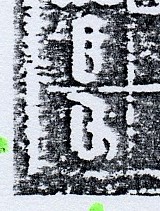
|
 carved in wood carved in wood
already this archaic variant of the
German Penny Sign is a "d" plus tail:
 = =
 + +

|
(wooden calculation board, Basels/Swizzerland) |
The upper symbol is a modification of a German "sharp s"
(= ss = ß) with a little tail below. At that time this was used as
monetary unit symbol for "Schilling" (shilling).
The lower symbol is an archaic form of the German Penny Sign.
Volume II "Zahlschrift und Rechnen" (Numeric Script and
Calculation), page 154, in the book "Zahlwort und Ziffer"
(Numerals and Ciphers), K. Menninger, published by
Vandenhoeck & Ruprecht, Göttingen 1958, 1979 (3rd edition)
|
| [02]: |
|
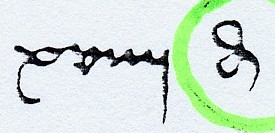
handwriting
= xviiij ₰
= 19 pennies
|
(manuscript from 1426, Straubing/Bavaria) |
for comparison a normal "d" in "lannd": 
on page 51 in the booklet "Unsere Schrift" (Our Script),
published by Degener & Co., Neustadt/Aisch in Germany 1961
|
In the 16th century: |
| [03]: |
|
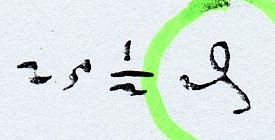
handwriting
= 25 ½ ₰
= 25.5 pennies
|
(manuscript from 1572, Reichenbach/Bavaria) |
also here the difference between the German Penny Sign
and the normal "d" is the attached tail
on page 95 in the booklet "Unsere Schrift" (Our Script),
published by Degener & Co., Neustadt/Aisch in Germany 1961
|
In the 19th century: |
| [04]: |
 |
the German Penny Sign in the description of the 1880
in New York for Germany produced pointer-typewriter "Hall"
(for Latin script)
for comparison the normal "d": 
on the very same machine
|
| [08]: |
 ! ! |
the German Penny Sign in a newspaper advertisement
in German Gothic Script (typical evidence)
in an issue of the "Mindelheimer Zeitung" (Mindelheim News)
from 1896
|
| [10]: |
 |
the German Penny Sign on the keyboard of the
typewriter "The Chicago" 1898, U.S.A.
(for Latin Script)
(produced for the export to Germany)
|
In the 20th century: |
| [11]: |
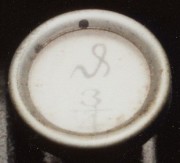 
original photo
contrast enhanced |
the German Penny Sign on the keyboard of the
typewriter "Perko" 1912, Dresden/Germany
(for Latin Script)
|
| [12]: |
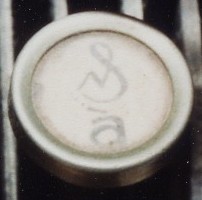 
original photo
contrast enhanced |
the German Penny Sign on the keyboard of the
typewriter "Triumph" 1918, Nuremberg/Germany
(for Latin Script)
|
| [13]: |
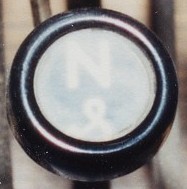 
original photo
contrast enhanced |
the German Penny Sign on the keyboard of the
typewriter "Adler" 1922, Frankfurt/Germany
(for Latin Script) |
| [15]: |
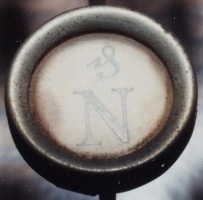 
original photo
contrast enhanced |
the German Penny Sign on the keyboard of the
typewriter "Underwood" 1926, U.S.A.
(for Latin Script)
(produced for the export to Germany)
|
| [16]: |

↑
on the control panel |
 |
bent for adjustment
←
on the type spindle
(2nd row from above)
|
|
the German Penny Sign on the
pointer-typewriter "Mignon" 1930, Berlin/Germany
(for Latin script, capital letters only!)
on the control panel appears the normal shape of the Penny
Symbol, however on the type spindle - side-inverted - a variant
of the Penny Sign with shortened descender can be seen:
the descender of the printed character is shortened,
because this machine was constructed for striking capital letters
without descenders only!
On the type spindle above the Penny Sign you can see the
German Pound Symbol (used only for weight), and below the
"cambered M", the German Mark Symbol at that time.
|
| [19]: |
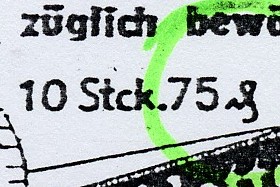
|
typical evidence
= 10 Stck.75₰
= 10 pieces at 75 pence
|
(in an issue of the periodical "Ratgeber" [=Adviser] from 1954) |
the German Penny Sign in an advertisement
for "Spalt"-tablets (aspirin), in Latin script
(this periodical I used much at that time to learn how to read)
|
| [20]: |
 |
printing in 1979
non-typical evidence
|
|
Example with the old resp. round German Penny Sign:
Normally this variant was used only together with Fraktur script,
only seldom together with Latin script.
Vol. II "Zahlschrift und Rechnen" (Numeric Script and
Calculation), page 168, in the book "Zahlwort und Ziffer"
(Numerals and Ciphers), K. Menninger, published by
Vandenhoeck & Ruprecht, Göttingen 1958, 1979 (3rd edition)
|
| |
The German Penny Sign is a fullsize symbol with descender, not a superscript symbol:
In school I learned to write the Penny Sign like this:

The proper size and positioning of the German Penny Sign can be seen in sample [19] (above)
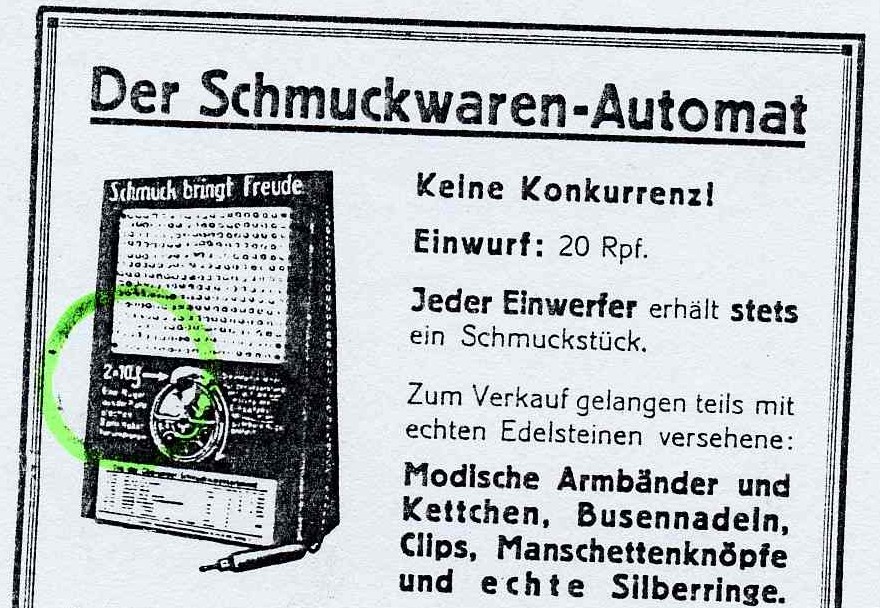
and also here in the picture of an old jewelry vending machine
(sample [17] in my originally filed application):
See the explanation for the user telling him that he has to insert "2× 10 pence →" -
on the machine you can see a very cursive (italic) variant of the normal German Penny Sign:

in the ad text however the official abbreviation used in those days can be seen: "Rpf." (= Reichspfennig)
(the German Penny Sign itself - without "Reich" - had been used already during 500 years before that time):
|
| |
Erroneous References: |
[21]:
 |
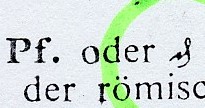 Brockhaus in the year 1972
The German Penny Sign shown here is wrong, because
the "d"
part is not placed on the baseline. It is positioned a little too high.
|
Though in elder printings of the German encyclopedia
"Brockhaus" this symbol was correctly represented, but
in the 1972 edition this symbol was not any more readily
available - so it got inserted photo-mechanically
in handwritten style instead of in the proper printed one.
|
[22]:
|
 Brockhaus in the year 1992
The German Penny Sign shown here is wrong, because its size
is too small, and it's superscripted instead of in normal position.
NB: Historic facts do not change ex post, but
the precision of the Brockhaus editions is decreasing critically.
|
In the "Brockhaus" from 1992 (19th edition) the German Penny
Sign is described even in a more misleading way (see left).
Different from the erroneous citation on the left, in running text
like the one shown, the Penny Sign was always used in full size
and grounded with its left part (the ancient "d") on the baseline,
and the tail on the right side formed a descender.
Only if the Penny Sign was positioned directly behind an
emphasized and therefore upsized number as e.g. in a price
tag, it could look like this:
10 .
This is comparable to writing 10$ instead of 10$. .
This is comparable to writing 10$ instead of 10$.
|
[--]:
|
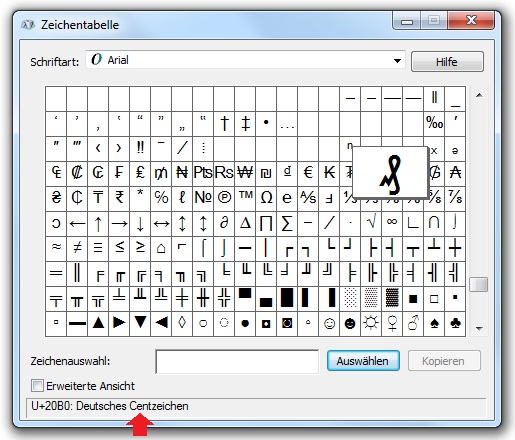
| An embarrassing blunder by Microsoft:
German edition of the Windows accessory program
"Zeichentabelle (English: "Character Map")
in Windows 7, Windows 8, and in Windows 10 :
The character is correct,
its name mentioned below is not.
I have no idea how such a fooling can come about ...
|
It's not a "German Cent Sign",
it's the German Penny Sign (in German: Deutsches Pfennigzeichen).
It can't be used for "Cent" or "Eurocent", only for Penny!
|

 in Unicode


 deutsch
 = 5 pieces 20 pence
