
Neoficiala amator-retejo
Paĝo Pri Poŝkomputiloj
La mondo de la privata komputado komencis 1974 kun la programeblaj poŝkomputiloj de usonaj firmaoj -
antaŭe nur grandaj komputiloj ekzistis, nepageblaj per ordinara homo ...
Jen kelkaj eksterordinaraj usonaj modeloj de tia tempo (la listo estas kompreneble nekompleta !):
Klavofrapo-programeblaj poŝkomputiloj kun volatila* memoro:
| ekde | bildo | modelo
(ekrano) |
RAM
+ ROM | RAM parto
por programoj
+ por datenoj |
registroj (= variabloj) | ekstera
datenportilo |
| 1974 |  |
Hewlett Packard HP-65
(15 ciferoj 8-segmentaj) |
0.2 KiB RAM
+ ? KiB ROM | 100 bajtoj
+ 63 bajtoj |
9 registroj "1"-"9" po 7 bajtoj
en la datenmemoro | magneta karto |
| 1975 |  |
Texas Instruments SR-52
(12 ciferoj 8-segmentaj)
| 0.5 KiB RAM
+? KiB ROM |
224 bajtoj
+ 176 bajtoj | 22 registroj "01"-"19", "99", "98" po 8 bajtoj
en la datenmemoro,
plus maksimume 28 pluaj
registroj "97"-"70", kiuj forprenas parton de la
programmemoro | magneta karto |
| 1976 |  |
Hewlett Packard HP-67
(14 ciferoj 8-segmentaj)
| 0.5 KiB RAM
+ ? KiB ROM |
224 bajtoj
+ 182 bajtoj | 26 registroj "A"-"Z" po 7 bajtoj en la
datenmemoro | magneta karto |
| 1977 |  |
Texas Instruments TI-58
(12 ciferoj 8-segmentaj) |
0.5 KiB RAM
+ ? KiB ROM
(opt. + 5 KiB) | 480 bajtoj
+ 0 bajtoj |
maks. 60 registroj po 8 bajtoj,
la registroj po 10 forprenas parton de la
programmemoro | - |
| 1977 |  |
Texas Instruments TI-59
(12 ciferoj 8-segmentaj) |
1 KiB RAM
+ ? KiB ROM
(opt. + 5 KiB) | 960 bajtoj
+ 0 bajtoj |
maks. 100 registroj po 8 bajtoj,
la registroj po 10 forprenas parton de la
programmemoro
(en kazo de 100 registroj
restas ankoraŭ 160 bajtoj por la programo) |
magneta karto |
*: volatila: forgesas la kontenuton kiam la aparato estas malŝaltata, RAM = skribebla kaj legebla memoro, ROM = nurlegebla memoro
Fotoj: © Hewlett-Packard, © Texas Instruments, el la originalaj prospektoj
Ĉirkaŭ 1978 la malmultan energion konsumantaj KMOS-memoro-ĉipoj
(KMOS signifas "komplementa metal-oksida semikonduktanto", "CMOS" en la angla) disvastiĝis, kaj la
produktantoj de la poŝkomputiloj tuj poste fabrikis modelojn kun baterie protektata, persista (= ne-volatila) memoro,
kiuj ne forgesis la kontenuton de sia memoro dum esti malŝaltita.
Depende de la produktanto tia propreco estis nomata "Constant Memory" (konstanta memoro), "Continuous Memory" (kontinua memoro),
"Static Memory" (statika memoro), aŭ simila.
Jen kelkaj eksterordinaraj modeloj de tia tempo kun ne-volatila memoro
(tiu listo estas precipe nekompleta, ĉar tiutempe ekzistis "sennombraj" klavofrapo-programeblaj modeloj !):
Klavofrapo-programeblaj poŝkomputiloj kun baterie protektata memoro:
| ekde | bildo | modelo
(ekrano) |
RAM
+ ROM | RAM parto
por programoj
+ por datenoj |
registroj (= variabloj) | laŭvola
ekstera
datenportilo |
| 1979 |  |
Texas Instruments TI-58C
(12 ciferoj 8-segmentaj)
|
0.5 KiB RAM
+ ? KiB ROM | 480 bajtoj
+ 0 bajtoj |
ĝis 60 registroj,
la registroj po 10 forprenas parton
de la programmemoro | - |
| 1979 |  |
Hewlett Packard HP-41C
(12 karaktroj)
|
0.5 KiB RAM
(maks. 2.5 KiB)
+ 12 KiB ROM | 441 bajtoj
+ 0 bajtoj
|
ĝis 63 (maksimume 319) registroj,
la registroj po 1 forprenas parton
de la programmemoro |
magneta karto |
| 1981 |  |
Hewlett Packard HP-41CV
(12 karaktroj)
|
2.5 KiB RAM,
(maks. 6.5 KiB)
+ 12 KiB ROM | 2233 bajtoj
+ 0 bajtoj |
ĝis 319 (maksimume 922) registroj,
la registroj po 1 forprenas parton
de la programmemoro |
magneta karto |
| 1981 |  |
Casio fx-602p
(11 karaktroj + 3 ciferoj)
|
0.8 KiB RAM,
+ ? KiB ROM | 512 bajtoj
+ 224 bajtoj |
22+6 registroj po 8 bajtoj en la
datenmemoro, plus 60 pluaj registroj,
kiuj po 1 forprenas parton de la
programmemoro | sonbendo |
| 1983 |  |
Hewlett Packard HP-41CX
(12 karaktroj) |
3.5 KiB RAM,
(maks. 6.5 KiB)
+ 24 KiB ROM | 2233+889 bajtoj
+ 0 bajtoj |
ĝis 319+127 (maks. 922) registroj,
la registroj po 1 forprenas parton
de la programmemoro | magneta karto |
RAM = skribebla kaj legebla memoro, ROM = nurlegebla memoro
Fotoj: © Hewlett-Packard, © Texas Instruments, el la originalaj prospektoj
Tiutempe memoro por unu glitkoma nombro nomiĝis "registro", kaj unu registro estis ĉe Hewlett-Packard
7 bajtoj, sed ĉe Texas Instruments, Sharp kaj Casio estis normale 8 bajtoj.
Se la HP-41C (1979) volis memori literojn en unu de siaj registroj, maksimume 6 literoj trovis spacon
(unu bajto servas por la interna longec-indiko), kontraŭe ekzemple ĉe la
Sharp PC-1211 (1980) 7 literoj trovis spacon.
Je 1980, unu jaro post la prezentado de la Hewlett-Packard HP-41C, tuj aperis japanaj firmaoj kun novmaniera
aparata koncepto:
- Kontraste kun la usonaj poĝkomputiloj, kiuj ligis la funkciojn kun apartaj klavoj kaj pro tio estis
klavofrapo-programeblaj, la japanoj decidiĝis por la altnivela programa lingvo "BASIC" (Baziko).
- Kontraste kun la usonaj poŝkomputiloj, kiuj uzis magnetajn kartojn kiel ekstera programportilo kaj datenportilo
(ĉiuj supere nomataj poŝkomputiloj krom la TI-58 aŭ enhavis skrib-leg-stacion por magnetaj kartoj, aŭ
ebligis ligi laŭvole ekstere tian stacion), la japanoj decidiĝis por ligeblaj kasedo-interfacoj,
per kiuj oni povis skribi programojn
kaj datenojn pepetante sur sonbenda.
Jen kelkaj eksterordinaraj japanaj modeloj de tia tempo (ankaŭ tiu listo estas nekompleta !):
Baziko- kaj C-programeblaj poŝkomputiloj kun baterie protektata memoro:
| ekde | bildo | modelo
(ekrano) |
RAM
+ ROM | RAM parto
por programoj
+ por datenoj |
registroj (= variabloj) | laŭvola
ekstera
datenportilo |
| 1980 |  |
Sharp PC-1210
(24 karaktroj) |
0.8 KiB RAM
+ ? KiB ROM | 400 bajtoj (Baziko)
+ 208 bajtoj (dat) |
26 variabloj A-Z = A$-Z$ = A(1)-A(26)
po 8 bajtoj en "dat", A(27)-A(76)
forprenas Baziko-memorparton |
sonbendo |
| 1980 |  |
Sharp PC-1211
(24 karaktroj) |
1.8 KiB RAM
+ ? KiB ROM | 1424 bajtoj (Baziko)
+ 208 bajtoj (dat) |
26 variabloj A-Z = A$-Z$ = A(1)-A(26)
po 8 bajtoj en "dat", A(27)-A(204)
forprenas Baziko-memorparton |
sonbendo |
| 1981 |  |
Casio FX-702P
(20 karaktroj) |
2 KiB RAM
(plilarĝigebla**)
+ ? KiB ROM | 1680 bajtoj (Baziko)
+ 208 bajtoj (dat) |
26 variabloj A-Z = A$-Z$ po 8 bajtoj
en "dat", pluaj variabloj
forprenas Baziko-memorparton |
sonbendo |
| 1981 |  |
Sharp PC-1500
(150 x 7 bilderoj) |
3.5 KiB RAM
(maks. 19.5 KiB)
+ 16 KiB ROM | 1850 bajtoj (Baziko)
+ 624 bajtoj (dat) |
26 variabloj A-Z po 8, kaj 26 variabloj
A$-Z$ po 16 bajtoj en "dat", pluaj
variabloj forprenas Baziko-memorparton |
sonbendo |
| 1983 |  |
Sharp PC-1500A
(150 x 7 bilderoj) |
8.5 KiB RAM
(maks. 24.5 KiB)
+ 16 KiB ROM | 5946 bajtoj (Baziko)
+ 624 bajtoj (dat) |
26 variabloj A-Z po 8, kaj 26 variabloj
A$-Z$ po 16 bajtoj en "dat", pluaj
variabloj forprenas Baziko-memorparton |
sonbendo |
| 1983 |  |
Sharp PC-1245
(16 karaktroj) |
2.2 KiB RAM
+ 24 KiB ROM | 1486 bajtoj (Baziko)
+ 208 bajtoj (dat) |
26 variabloj A-Z po 8 bajtoj en "dat",
pluaj variabloj forprenas
Baziko-memorparton |
sonbendo |
| 1983 |  |
Casio PB-700
(160 x 32 bilderoj) |
4 KiB RAM
(maks. 16 KiB)
+ 25 KiB ROM | 2864 bajtoj (Baziko)
+ 208 bajtoj (dat) |
26 variabloj A-Z = A$-Z$ po 8 bajtoj
en "dat", pluaj variabloj
forprenas Baziko-memorparton |
sonbendo |
| 1984 |  |
Sharp PC-1350
(150 x 32 bilderoj) |
5 KiB RAM
(maks. 21 KiB)
+ 40 KiB ROM | 3070 bajtoj (Baziko)
+ 208 bajtoj (dat) |
26 variabloj A-Z = A$-Z$ = A(1)-A(26)
po 8 bajtoj en "dat", pluaj variabloj
forprenas Baziko-memorparton |
sonbendo |
| 1986 |  |
Casio FX-850P
(32 x 2 karaktroj) |
8 KiB RAM
(maks. 40 KiB)
+ 128 KiB ROM | 1536 bajtoj (Baziko)
+ 3536 bajtoj * (lab) |
variabloj enestas en "lab",
RAM-dosieroj forprenas
Baziko-memorparton |
sonbendo |
| 1986 | 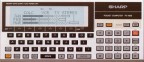 |
Sharp PC-1600
(156 x 32 bilderoj) |
16 KiB RAM
(maks. 80 KiB)
+ 96 KiB ROM | 12090 bajtoj (Baziko)
+ 624 bajtoj (dat) |
26 variabloj A-Z po 8, kaj 26 variabloj
A$-Z$ po 16 bajtoj en "dat", pluaj
variabloj forprenas Baziko-memorparton |
sonbendo,
2.5"-diskedo
kun 2×64KiB |
| 1989 |  |
Casio PB-2000C
(192 x 32 bilderoj) |
32 KiB RAM
(maks. 64 KiB)
+ 96 KiB ROM | 20992 bajtoj (C)
+ 1024 bajtoj* (lab)
+ 4095 bajtoj* (dos) |
variabloj enestas en "lab",
RAM-dosieroj en "dos", pluaj variabloj
aŭ dosieroj forprenas C-memorparton |
sonbendo,
3.5"-diskedo
kun 360 KiB |
| La 16-bit-erao de la poŝkomputiloj komencas:
la sekvantaj modeloj havas CP-on 80L188EB (Intel 80186-kompatibila) |
| 1991 |  |
Casio Z-1
(192 x 32 bilderoj) |
32 KiB RAM
(maks. 64 KiB)
+ 96 KiB ROM ? | 18412 bajtoj (C, Baziko)
+ 6144 bajtoj* (lab) |
variabloj enestas en "lab",
RAM-dosieroj forprenas
Baziko-memorparton |
3.5"-diskedo
kun 640/720/
1232 KiB |
| 1991 |  |
Casio FX-890P
(192 x 32 bilderoj) |
64 KiB RAM
(maks. 96 KiB)
+ 96 KiB ROM ? | 51180 bajtoj (C, Baziko)
+ 6144 bajtoj* (lab) |
variabloj enestas en "lab",
RAM-dosieroj forprenas
Baziko-memorparton |
3.5"-diskedo
kun 640/720/
1232 KiB |
CP = centra procezilo, RAM = skribebla kaj legebla memoro, ROM = nurlegebla memoro
Fotoj de FX-702P, PB-700, PB-2000C: © Casio,
Fotoj de PC-1350, PC-1600: © Sharp, el la originalaj prospektoj
la aliaj fotoj © Elmar Dünßer (Duensser)
*: aŭtomate alĝustigita valoro, ŝanĝebla - kaze de pli grandaj valoroj la programmemoro ŝrumpas konforme
**: la origine planita memoro-plilarĝigo por la "Casio FX-702P" neniam aperis
Multaj oldaj komputiloj paliĝas en nia memoro (kaj mi jam legis kelkspecajn nekorektajn informojn pri ili en la Interreto),
sed la ĉarmon de multaj de la supre menciitaj komputiloj mi ne forgesis ĝis nun - ili posedis baterie protektatan
memoron, kiu ne forgesis nenion kiam malŝaltita, kaj operacian sistemon, kiu estis senfuŝigita jam antaŭ la vendo,
kaj pro tio ĝi povis esti enmetita en ROM: oni povis simple malŝalti la komputilon kaj ĝi estis malŝaltita,
kaj kiam oni ŝaltis ĝin, ĝi tuj reaktivigis - ekzakte en la sama loko kiel antaŭ la malŝalto !
Estas malgajiga, ke nun ni devas barakti kontraŭ malrapide startantaj tekkomputiloj, kaj eĉ la modernaj manporteblaj
komputiloj "PDA" (= persona daten-asistanto) kun "Poŝa Vindozo" - la modernaj sekvantoj de la poŝkomputiloj -
bezonas iometon da tempo por starti ...
Atentigoj pri la terminoj KiB, MiB, PK kaj kompatibila

AVIZO: Ĉiuj informoj en tiu retejo estas korektaj laŭ mia scio, sed estas donataj sen garantio.
Tio estas ne-komerca amator-retejo
© 2005-2006 Elmar Dünßer (Duensser)
|
 deutsch
